Showing posts with label review. Show all posts

Sunday, September 9, 2018

Literature Review | The Dark Tower VII (The Dark Tower)


Song of Turtle and Cry of the Bear…the Tower is at hand.
Published in 2004, The Dark Tower is the concluding volume of Stephen King’s long-running magnum opus.  Picking up where Song of Susannah left off, the Ka’tet continue their attempts to thwart the Crimson King’s plan to bring the Tower down.  This entails finding a way to prevent the final two beams from snapping and preventing Stephen King from dying.  If either occurs, Discordia rules.  Mia’s chap adds further tension to the tet’s precarious situation.  While young, he possesses powers similar to that of the Crimson King, and is at hand to interfere.  Bullets will fly, and blood will shed before the tower is reached, and not all will end happily.  All that matters is that the Tower stands.
                King’s prose is consistent with the prior two entries.  Not my favorite as a whole, but there are moments that could easily make a favorite’s list, one of which I’ll address later.  While there are several passages that might drag for certain constant readers—I admit I had this issue several years ago during my first read through—this didn’t bother me the second time.  My mind has grown in the seven years since I first read the series, increasing my patience and eye for detail.  However, this still doesn’t temper my one criticism when it comes to length.  While I do concede that Song of Susannah’s ending made for an excellent cliffhanger, the first section of this entry could easily have been the climax.  The Mia thread would have been tied up and Book Seven could have begun with the Breakers.  Other than that, the novel’s length isn’t an issue.
                King introduces several new high speech phrases as the plot progresses, mainly location names.  While he felt that doing so would bog things down—and probably because King is not a linguistics expert like Tolkien was—this introduction adds weight to the High Speech.  Having it automatically translated was nice for clarity, but directly hearing the words builds upon Roland’s world.  It also makes me wonder what a conversation in the language would sound like.   
                Introduced in the previous entry, King further elaborates on the Breakers, specifically their culture.  Constant Readers knew Breakers were kidnapped from different levels of the Tower by the Can-toi, but Ted Brautigan gives us a firsthand account of the process.  While not exactly the same, the initiation is akin to joining the mob.  Once you’re in, you’re in for good.  Readers also learn that despite being unable to leave, Breakers are treated like VIP’s.  Because of this, many don’t have the desire to leave.  When their world is turned upside down, most of them are unsure what to do.  It seems using their minds to break the Tower has robbed them of other mental faculties.  Originally introduced in King’s work Hearts in Atlantis, Ted is a likable character, even though his past contains its fair share of sins.  Breaking the beams is his latest one, although he has tried his best to postpone the fall.  Aiding the Ka-tet is how he’ll set things right. 
                Ted is not the only older character to impact the plot dramatically.  Patrick Danville, an artist introduced as a child in Insomnia, returns as the third act begins.  Found in the clutches of a vampire, Patrick is emaciated and his tongue has been ripped out.  While an odd return at first, as the plot draws to a close the audience learns that Patrick possesses an important power.  With his art, Patrick can manipulate the universe.  Foreshadowed by the horizontal shifting of a bison herd, the power is revealed when Susannah asks Patrick to edit one of his drawings.  In addition to shifting the location of people or things, Patrick can create and destroy.  The Crimson King fears this power, which is why Patrick has been locked away.  While some might question why Patrick remains alive, but considering how usefully the power is—and how greedy his keeper’s hunger can be—it is more sensible to keep the artist alive.
                King’s Meta insertion continues.  While it reaches its logical conclusion, it could further turn off those who didn’t appreciate or agree with this narrative choice.  As Song’s epilogue hinted, King inserts his late 90’s van accident into the plot, interpreting it as an attempt on his life by the Crimson King.  If left alone, this attempt will succeed, King will die with the series unfinished, leaving the path to Discordia unobstructed.  The Ka-tet move to prevent this.  While they succeed in saving King’s life, it comes at the cost of Jake’s own.  This devastates Roland, as the gunslinger had promised Jake he wouldn’t let him die again.  While this wasn’t a repeat of the fall, the gunslinger still blames himself considering it was for the Tower.  He curses King for laziness, but leaves it at berating.  Ka punishes the wordslinger enough with pain, curing Roland of his own hip ailment in the process.  One could argue this is a plot convenience, but given their physical similarities I’d say he was holding it for King.  Jake’s burial is respectful, allowing Roland and Oy the appropriate level of mourning before they must march on.  Jake is gone, but the Tower calls. 
                This leads into my next point:  the breaking of the Tet.  Foreshadowed constantly throughout the previous four books, it was only a matter of time before tragedy shattered the group.  That tragedy takes place slowly as the characters fall one by one.  While not an official member, Callahan is the first to fall, his death occurring inside the Dixie Pig.  For fans of ‘Salem’s Lot, this moment is bitter sweet.  While it is sad that the character dies, readers can find solace in Callahan’s redemption.  Ruined no more, he puts up a decent spiritual fight against Barlow’s fellow vampire elders, his own strength amplified by Maturin  In the end, elders are too strong for Callahan and he takes his own life, his last middle finger at the beings who have plagued him for years.  Before doing so, he leaves Roland with some parting words, ones that will encourage the gunslinger during this endgame.
                Eddie Dean falls next.  The first member that Roland drew on the shore of the Western Sea, it is fitting that he is also the first member to die.  Victory was in sight, and an oversight cost the jester his life.  Although he holds on for a while, even a gunslinger cannot hold back death.  His loss devastates Susannah, as Eddie was her motivation for moving forward to the tower.  With him gone, her only reason to continue is loyally to Roland and Eddie’s memory.  Eddie’s death also spiritually breaks the Ka’tet.  While the remaining four are still a group, their link has been severed.
                While not as obvious as in novels like IT, King’s Lovecraftian influence does surface.  The creature encountered in the novels later half reminds me of the beings from The Shadow Out of Time.  Both inhabit subterranean lairs, waiting for unsuspecting prey to enter their domains.  To use a video game analogy, it comes across as a dungeon boss, there to test the players before they move onto the next area. 
                A McGuffin for the previous novel, Mia’s chap has been promoted to secondary antagonist.  Named after King Arthur’s bastard son, Mordred serves the same purpose as his classical namesake, with King’s stylistic twist.  The chap has two fathers:  Roland and the Crimson King, each representing Mordred’s Mortal and Cosmic halves.  While Mordred’s wishes echo those of the Crimson King, there are moments that make one wonder what could have happened if he had chosen to follow Roland.  Given the thematic nature of his namesake it wouldn’t surprise me if this road would have led to Roland’s death.   Despite his placement in the hierarchy, Mordred’s inner monologues betray how naïve the wereling is.  He blindly follows his cosmic father like any child who’s been indoctrinated, echoing sentiments without thought.  While his powers enable him to see behind Randall Flagg, he is unable to see beyond what lays in front of him, which leads to his undoing. 
King’s most obvious callback is the series main antagonists, Randall Flagg and the Crimson King.  While originally created as a demon, Flagg’s backstory has been fleshed out by this series.  While still evil, he has become well-rounded as the audience learns details of his early life.  While not all is spelled out, enough is written for the Constant Reader to connect dots.  Flagg is definitely an emissary in the Nyarlthotep mold.  Both are the right hands of their respective masters, and shapeshift to suit their needs.  Both also seemingly undermine their master’s schemes, although for Howard’s creation it’s harder to say if this is intentional or an afterthought.  No such ambiguity exists with Flagg, as his thoughts betray his desire to climb the tower.  These thoughts eventually lead to his demise, one fitting for a character readers have hated for decades.  Suffering madness for madness’s right hand. 
Hinted at in the previous three novels, constant readers finally see the Crimson King.  While he had appeared in Insomnia, having not read that novel yet I cannot comment or contrast.  Here, readers find the King trapped on one of the Tower’s balconies, driven mad by his circumstances; forever at the Tower, but unable to summit.  Like King’s accident, this plot development did turn off some readers.  The Crimson King was built up as the Multiverses main antagonist, and yet he’s an insane elderly man in red robes.  While I can understand this disappointment to an extent, the King’s predicament never bothered me.  It seemed logical given his circumstances.  Having read some of Lovecraft’s work since then, I’ve grown to appreciate this development further, as I’ve found Stephen King’s inspiration within the text.  If Flagg is our Nyarlethotep, then the Crimson King is Azathoth.  While he didn’t directly create the universe, he is a cosmic being whose existence threatens humanities own.  While Azathoth is kept sleeping by his otherworldly court, the King is trapped by a force—hinted to be Gan—beyond his control.  While I’m not declaring that one should drop any criticism of this development, this knowledge should factor into one’s view.  Just don’t go mad. 
                Like Flagg, the Crimson King’s end is fitting.  While Roland does engage the King in a firefight, it is posturing.  The King is expressing his anger while Roland is defending himself.  This impasse forces the gunslinger to attempt another way around, thinking around a corner to use his own terminology.  While not his best area, Roland does manage to scrape together the perfect plan.  Patrick draws the Crimson King, erasing him from existence as he erases the art.  Patrick only leaves the King’s eyes, cursing him to an eternity of voyeurism.
                While it is hard to begin, sometimes it is equally hard to end.  This is especially true for a series.  King is well aware of this, which is why The Dark Tower’s ending comes with a Dante warning once Roland crosses the threshold.  After said warning, Roland ascends the Tower slowly, each level representing a moment from his past.  This is the reader’s first hint of what is to come, but for the gunslinger it allows him to confront the ghosts of days gone by.  Regret has always hung over his head, and in the tower it is given form.  Roland endures until he reaches the top, where he is greeted by a single door.  A callback to his conversation with The Man in Black, this is the moment Roland has spent years perusing.  Without hesitation, Roland opens the door.  While not a door to some cosmic macroverse, Roland is terrified by what lays beyond the threshold and understands its meaning.  Not only has he reached the Tower before, but it has cast him back to an earlier point upon reaching the top.  While he attempts to fight, the hands of Gan are cruel and his effort is in vain.  While this development won’t please every reader—I’ve read several reviews where the individual has made their disappointment and distain clear—given the nature of Roland’s character and his arc throughout the series, it works.  A truly happy ending for him might not have worked as well.
Back in the desert at his moment of epiphany, Roland is left with no memories of his previous journey prior to that point, although his hands and gear are restored.  While cruel, the Tower has left the Gunslinger with one symbol of hope:  the Horn of Eld.  While he lost it at the Battle of Jericho Hill and lamented not taking the time to retrieve it in the main story, here Roland managed to do so.  While small, this infers to the reader that while Roland’s quest is damnation for now, eventually he will succeed and find peace.  How and when are left to the reader.  With that, the story ends as it began:  “The Man in Black fled across the desert, and the Gunslinger followed.” 

Wednesday, July 25, 2018

Movie Review | Deadpool

All great love stories begin the same way:  boy meets girl, they bond emotionally, and boy is subjected to dangerous medical experiments.  Okay, not all love stories begin that way, but this one does. 
Deadpool is a 2016 action-comedy film based on the titular Marvel character.  Detailing his origin story, the audience is introduced to Wade Wilson (Ryan Reynolds) in the months leading up to his transformation.  We see him work, fall in love, propose, and develop terminal cancer.  Desperate for a cure, Wade volunteers for a program designed to create mutants; the catch is he’ll be subjected to extreme pain.  Run by the dastardly Ajax (aka Francis, Ed Skrein), the program gives Wade Logan-level healing, but disfigures his skin.  Angered and driven by unyielding desire, Wade is out to kill Francis, and find a cure for his disfigurement.
This was a film I dreaded re-watching.  While I enjoyed it in theaters, as time progressed I feared subsequent viewings would temper my enjoyment and kill the film.  While not that extreme, I didn’t laugh as much this time around.  Some jokes drew simple chuckles, while others a head-tilt.  That said, there are several moments where the humor works perfectly, and I genuinely laughed; Wade’s bridge fight with Colossus and the Minion offing montage are great examples.
The action scenes were executed competently, and at times complement the comedy.  Other than a handful of rubbery moments the special effects look great, especially Colossus.  While I still prefer the use of practical suits when possible, his superb rendering receives my stamp of approval.  What makes this feat more impressive is that Deadpool was produced for approximately $58 million, which is tiny compared to other comic book films; most Marvel Cinematic Universe films cost over $150 million.
Like with the X-men films, the acting is decent all around.  Ed Skrein is fine as Francis; he doesn’t stand-out when compared to other comic book film villains, but he serves the film's purpose.  He’s evil enough without being overblown or underdone.   Morena Baccarin works well in her scenes, and she has an interesting chemistry with Reynolds; makes their characters relationship stand-out.  TJ Miller is ok as Wade’s friend Weasel, serving as the subdued half of the friendship.  While not a deep performance, Brianna Hildebrand is perfect as Negasonic, striking the correct balance of teenage smug and joy; she also has a decent back-and-forth with Reynolds. 
Speaking of which, Ryan Reynolds gives the films best performance.  His passion for the character and film are evident every second he’s on screen.  While not the best actor—a fact the film pokes fun at—Reynolds has great comedic timing and his vocal inflections were spot on, especially once he’s put on the mask.  He also has great chemistry with his co-stars, to varying degrees.  While another actor could have played Wade, the film wouldn’t have been the same; heck, it might not have even been made if it weren’t for Reynolds passion and connection with the fans.  For that, he deserves a 21-chimichanga salute.
Tom Holkenborg’s score was decent.  No pieces instantly pop into my head, but they served the scenes.  What dazzled me auditorily was the use of popular music.  While not worked in as perfectly as Starlord’s mixed tape, the songs serve the film well, although the only tune that jumps into my head is “Careless Whisper.”  Thank you Seether for the cover.
While its luster has somewhat faded, Deadpool is still an entertaining film, carried by a lead whose heart is in the project.  While the sequel was better overall, it was a decent first step forward; once two hits home video I see a double feature in my future.  3.5 out of 5 chimichangas.

Monday, July 16, 2018

First Impressions | Reunited (Steven Universe)


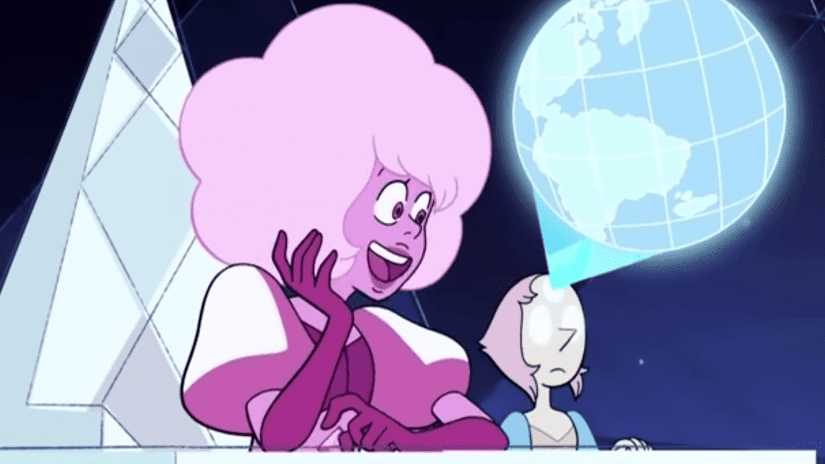
I’ve heard of Diamond’s setting one in motion, but this is the first time I’ve seen Diamond’s end a wedding.
                “Reunited” is the concluding episode of the latest Steven Bomb.  Picking up where “Made of honor “left off, the wedding day has arrived.  Everything is set and the guests are gathered.  While a cloud hangs over, Steven does his best to push it away through song.  The wedding goes off without a hitch, but things turn dark during the reception as Yellow and Blue have finally come for the cluster.  Now it’s a battle for survival; Crystal Gems vs Diamond authority, No Holds Barred.  Curse you leaks for spoiling the ending.
                Having Steven begin the episode with a song felt right.  Zach’s vocal delivery was spot-on, carrying the right balance of emotion, tone and diction.  With everything that’s come to light this season, a cloud hangs over the Crystal Gems, as each deal with her own issues (Pearl with her secret, Peridot with Lapis, etc.).  As planner and friend, Steven focuses their attention back on the wedding.  While the issues are pressing, they will still be there after the wedding; why let them drag down the day? As the title states, today lets only think about love. 
                Ruby and Sapphire’s wedding was executed beautifully.  Peridot was an excellent flower girl, tossing them as only she can; I’m surprised there wasn’t a gag related her dress, but given how long she’s been with the Crystal Gems now it might have been viewed as redundant.  I applaud Rebecca Sugar and her team for switching things up and putting Ruby in the wedding gown.    Given how certain parts of the world censor aspects of the show for being too “gay,” this will make said censorship harder to execute.  While that was nice, what made this episode groundbreaking was the kiss.  While the couple have been affectionate before, this is the first full-on kiss depicted between the two; what better moment to show.  All the Gem’s human friends were in attendance, including Uncle Andy.  Episode pacing might be the answer, but I’m surprised he didn’t receive a single line.
                The episode turns serious once the Diamonds appear, having come for the Cluster.  While the gemstrocity hasn’t been a threat since Steven helped bubble them, the Homeworld Matriarchs destabilize this harmony.  Thankfully the Cluster retains enough sentience to know friend from foe.  While the Cluster Battles Yellow, the Crystal Gems fight Blue.  Even Lapis returns to help.  While she had feared the Diamond’s before, her reasoning is sensible:  if she’s going to be punished for being a Crystal Gem, she might as well stand with her friends.  Steven attempts to talk the situation out, but the grief-stricken diamond refuses to listen.  The fight is well choreographed and animated, feeling like a video-game boss battle at times.  Blue tanks everything, including Lapis dropping the barn on her.  The Diamonds had been talked up prior to this episode, but now we finally see the extent of their powers and durability.  On the Gem side, Steven shows how strong his shield has become, although he still has room for improvement.  Blue even shatters Rose’s sword.  While a simple action, given the episode’s ending it can be interpreted as the ending of one stage of Steven’s journey and the beginning of another.
                The climax reveals Steven’s mind-touch power has one further step.  After Yellow knocks him out, Steven enters a strange, ethereal dimension.  He can interact with Connie and the Gems, but only when engaging in physical contact.  He uses this dimension to boost his allies’ moral and attempt to reason with Blue and Yellow.  This reasoning leads to the Diamond’s attacking Steven together, and Steven finally revealing his latent Diamond abilities.  These abilities get through to the matriarchs, which leads to one of my favorite moments of both the Bomb and the series:  Blue and Yellow showing concern for Steven.  It’s a tossup between which Diamond has the cuter reaction.
                Like all good things, the Bomb’s ending means another brief hiatus is upon Steven Universe fans.  While past hiatuses have been during questionable points in the season—especially if only one episode contained vital story information— “Reunited” ends in a manner befitting a cliffhanger.   This episode could have been a season finale if Rebecca had wanted.  Like past hiatuses, there is a teaser.  While the previously leaked clip is not included, it shows Blue and Yellow are curious about how Pink survived.  While unsaid, they will probably inquire as to why Pink is in her current form.  Yellow’s reaction to her sister loving organic life—including having a child with one—should be interesting.  Like many of you, I also wonder how the pair will react to corrupted gems.  Will they be shocked at the results of their previous attack, or that corrupted gems can survive that long?
                It goes without saying that “Reunited” is one of my favorite episodes of Season 5.  While I haven’t gone back and watched every episode of the series yet—seeing early clips out of sequence will do that to you—I am confident in proclaiming this one of my top five favorites of the series.

Wednesday, July 11, 2018

First Impressions | What's Your Problem & The Question (Steven Universe)

I’m sorry for the delay; work following the first episode was hectic, and it was quickly followed by Anime Expo, which as an aside was fun; finally managed to hit up a Steven Universe Cosplay meetup, where I was one of two Gregs.  Sadly, still searching for pictures.  Now, with that out of the way, onto the episodes.
                “What’s Your Problem” and “The Question” are the second and third respective episodes of the latest Steven Bomb.  Picking up where the first part left off, Ruby is missing following Sapphire’s outburst.  Steven and Amethyst leave to find the Enteral Flame, but she is nowhere in Beach City.  This search leads to another bonding moment between the two.  A pizza stop leads them to Ruby, who has been calmed down by Greg but desires alone time.  This time alone leads to Ruby experiencing life as a cowboy and reflecting on her life. 
                While Amethyst blew off the Pink-Rose revelation initially, her guard slowly lowers as Problem progresses.  This lowering takes the form of frustration; at first it appears to be because of Ruby’s elusiveness, but it soon becomes apparent Amethyst is frustrated at the revelation and its implications for the Crystal Gems.  Amethyst feels that they shouldn’t have to deal with the mistakes Pink made.  While naïve when it comes to future encounters with Homeworld Gems, Amethyst has a point when it comes to their inner circle.  Pink lied to everyone, but that shouldn’t change how they feel about each other and Steven; the mother’s sins should not damn the son. 
                Ruby enjoy her alone time.  While she has been unfused before, the Eternal Flame has never had time away from Sapphire since that day in Blue Diamond’s court.  Even partners in the best relationships need me time, so this is long overdue.  As said before, Ruby masquerades as a cowboy, complete with hat, chaps and trail song; it’s always nice when Rebecca Sugar include a musical number, and hearing Charlyne Yi’s vocals is a bonus.  While Ruby enjoys herself, she misses Sapphire.  As the episode title foreshadows, this leads to Ruby asking Sapphire to marry her, a moment where every SU fan shrieked with glee.  While not a custom gems normally practice considering relationships between different casts are unheard of on Homeworld, it is romantic nevertheless.  Some might question the why, but Ruby’s reasoning is logical:  once married, even when the pair are unfused they will always be together.
                While only mentioned in passing, Greg talking Ruby down is an excellent touch.  Being the Crystal Gems longtime human friend, he knows their personalities and quirks well.  While he might not engage with Ruby as often, he knows her well enough to engage in deep conversation.  His reaction to Pink-Rose is what I expected; he’s fine with the truth, although I feel part of him wonders why Pink never told him the truth.  His spoken reasoning is logical, even if slightly humorous.  After this, Greg remains in the background as Ruby plays rider, but his dedication to friendship shines nonetheless.

                While not as packed as the two episodes that preceded them, “What’s Your Problem” and “The Question” both provided moments of character development and bonding that build beautifully off what came before.  The latter shows why this Bomb is called “The Heart of the Crystal Gems,” and hooks the audience for the final two.

Tuesday, July 3, 2018

First Impressions | Now We're Only Falling Apart (Steven Universe)

                “Rose Quartz was actually Pink Diamond!”  That revelation shattered everything SU fans thought they knew about the original leader of the Crystal Gems.  The fandom was split.  Some defended her while others lambasted her choices.  While I see the wisdom in both sides, I chose to wait for the Summer episodes before casting stones either way; information and proper context.  The latest Steven Bomb is upon us, and with the first episode SU fans have their answers, although I’m sure some corners of the fandom will still be annoyed.
                “Now We’re Only Falling Apart” picks up where the last episode left off, with the Crystal Gems digesting Pearl’s revelation.  Amethyst seemingly takes the revelation in stride—which is logical considering she was born after the war—but it literally destroys Garnet, undoing her fusion faster than Pearl’s previous lie.  This time it is Sapphire who is hurt, lambasting Pink for lying to them and cursing herself for not having seen this with her Future Vision.  She then storms off, with Steven and Pearl following to help calm the stormy gem down.  This calming involves another flashback, where more information is divulged about Pink Diamond’s past, including why she created Rose Quartz.
                Considering where the previous cliffhanger left this, character reactions and interactions were logical.  Amethyst has only known Pink as Rose and not having lived through the war she doesn’t have that painful baggage.  When combined with her laid-back demeanor, its logical she’d quickly forgive the lie.  Steven still seems to be digesting the information, which will most likely be his character arc through this Bomb.  Pearl is relieved, as a weight she’s been carrying for thousands of years is gone and she can finally speak freely, which she admits during the episode’s opening.  Garnet is the one I feel for.  Not only is her fusion undone, but everything she’s ever known since that day in Blue Diamond’s court is questionable.  Sapphire voices as much before she leaves, although she does take things too far.  Even if she’s upset, telling Ruby their relationship is based on a lie—among other things—is crossing the line.  Even when Ruby was mad before the Eternal Flame never spoke that harshly to her icy flame.  Given how much words can hurt it’s no wonder Ruby’s gone by the end.
                Pink Diamond’s backstory is the episode’s meat.  While the audience has heard stories about her before, the Rose revelation put everything into question, necessitating further exposition from Pearl.  We get that here.  While Pearl doesn’t reveal how Pink managed to get a colony—my guess is Yellow finally gave in—she goes into detail about how excited Pink was once her Quartz soldiers began to hatch.  This is where Rose was created.  Pink wanted to move among them, but couldn’t in her true form without hearing about it from her sisters.  One suggestion from Pearl and Rose is born.  As Pink explores her colony she slowly realizes how destructive Gem creation is to organic life.  As she puts it, “We’re not creating life from nothing.  We’re taking life and leaving nothing behind.”  She does attempt to undo the colony, but is overruled.  This is where her ultimate choice comes into play.  The Diamonds won’t listen to Pink, but they will pay attention to Rose Quartz. 
While some might still find this selfish—a viewpoint I respectfully disagree with—the Garnet situation makes it harder to throw that term.  While Pink originally was fighting to save organic life on Earth, Garnet’s creation added to her motivation.  She was not only fighting for Earth.  She was fighting for free Gems.  While the logic behind her ultimate decision can still be questioned—it is naïve on her part to assume Yellow and Blue wouldn’t do anything if their little sister was shattered—the why she made that choice is easy to see.  Pink did it for Earth and for Garnet.  Even if her specific actions were flawed, her heart was in the right place.
                In addition to Pink’s backstory, Pearl’s exposition also provides more information about her unrequited love.  While all Pearl’s adore their owners to a certain degree, as the story unfolds it becomes clear that Pearl was attracted to Pink’s boldness and dedication to her beliefs.  At first, this was awkward since it went against Pearl’s purpose, but over time this lessened; not everything is shown, but enough is divulged for the audience to fill in the blanks.  While brief, it was cute that Steven pointed out that Pearl’s feelings helped shaped Pink’s resolve, which garnered an appropriate subtle response from the gem
Some members of the fandom—hopefully a minority—are still calling Pink selfish when it comes to Pearl’s feelings.  While everything is entitled to his or her opinion, this is a view I’ll never understand.  One is not entitled to return another’s romantic feelings, even if they’ve been friends for millennia.  Feelings must develop naturally.  Despite their closeness—and the existence of Rainbow Quartz—Pink was under no obligation to love Pearl.  If she’s guilty of anything it’s being oblivious of the affections or ignoring and exploiting them.  It’s hard to say which one right now.

As a whole, “Now We’re Only Falling Apart” was a great episode.  It filled in backstory gaps, delivered moments of past and present character development and sets up the next several episodes nicely.  Boy, Sapphire’s going to need more than balloons and cake.  

Sunday, May 6, 2018

Reader Response | Significance of Poe's "The Raven"

Published in 1844, “The Raven” is one of Edgar Allen Poe’s most well-known poems.  When examining the prose’s wording, the first thing that stands out is Poe’s use of alliteration and rhyme.  Line one gives the reader a perfect example of both.  “Once upon a midnight dreary, while I pondered, weak and weary” (675).  Weak and weary both begin with W, and their close placement is alliteration.  Weary also rhymes with dreary, causing the literary devices to be linked from the work’s beginning.  This doubling of alliteration and rhyme continues throughout the prose (Ex: Deep and darkness for alliteration, peering and fearing for rhyme, Line 25). Combined, the pair allows the poem’s words to flow melodically; a reader cannot help but read “The Raven” in a musical fashion. 
            The title bird is worthy of deep discussion.  From the moment he flies into the poem, the narrator’s curiosity is peaked by the Raven.  The narrator describes the bird as stately from “the saintly days of yore” (676, Line 38).  This description informs the reader that the Raven is dignified and most likely supernatural.  To add to this, the bird perches on a bust Athena, daughter of Zeus and Greek goddess of Wisdom.  To use stage terminology, this an interesting blocking choice on Poe’s part, and it serves as foreshadowing for the poem’s later stanzas.  As the poem continues, the narrator becomes frustrated by the Raven’s inability or refusal to answer his questions, simply cawing the iconic phrase “Nevermore” repeatedly.  This changes the narrator’s impression of the bird, referring to the avian creature as a “grim, ungainly, ghastly, gaunt and ominous bird of yore” (677, Line 71).  While bogged down with descriptors, this passage informs the reader that the narrator is now displeased and frightened by the Raven’s presence, seeing the bird as an omen of disastrous repute.  The Raven is still supernatural, but of Hell, not Heaven.
            The Narrator’s impression aside, what does the Raven stand for?  After rereading the text, the answer becomes obvious.  The Raven is the personification of the narrator’s grief.  Sometime before the work began, Lenore—implied to be the narrator’s wife or fiancé—passed away.  The narrator now begins to read old literary works, hoping to find “surcease of sorrow” (675, Line 10).  Surcease translates as cessation, so the narrator is attempting to cast out his sorrow.  Once the Raven appears, his presence torments the narrator, pecking at his sanity as only grief can.  “Take thy beak from out my heart, and take thy form from off my door” (678, Line 101).  With these words, the narrator is attempting to permanently drive the bird away, and in doing so end his internal suffering.  This attempt fails.  The Raven remains perched, and thus grief remains.
            This is a deep sentiment.  Everyone has encountered grief in their lives at one point, usually from the death of a loved one.  While we mourn the loss, a part of that loss never goes away; how much depends on the circumstances.  An untimely death would be towards the top of the list.  While the narrator is unnamed, one can see a lot of Poe in him.  Poe his young wife to tuberculous, and certain accounts state he never fully recovered from her death before meeting his own.  While she still lived when Poe composed “The Raven,” she had contracted the illness.  In that regard, “The Raven” is Poe’s statement about what he was about to experience.  While it might appear he moved on, like the ebony bird, his grief would remain evermore.

Wednesday, May 2, 2018

First Impressions | Avengers Infinity War

While it has its highs and lows, I consider myself a fan of the Marvel Cinematic Universe.  Like many of my fellow fans, my anticipation grew as Phase One’s end grew closer, watching each film in theaters.  This anticipation grew further when The Avengers premiered.  While not perfect, it was a satisfying end to Phase One, and its mid-credits scene perfectly set up future story arcs.  That scene gave us the first film appearance of the mad Titan, Thanos.  While I had no idea who he was at first, a quick google search was enlightening.  This peaked my interest, which continued to grow as Phase Two and Phase Three moved forward.  While his on-screen appearances were brief, Thanos (Josh Brolin) hung over the MCU like a rain cloud, waiting for the precise moment to burst.  That moment has come with Avengers Infinity Wars.  
As the title suggests, the film’s plot focuses on the Infinity Stones, McGuffin’s introduced during Phase One and elaborated on during Phase Two.  Thanos’ goal is to collect all six stones and place them in his Infinity Gauntlet, which would give him the power to balance the universe.  It is up to both the Avengers and the Guardians of the Galaxy to thwart Thanos, but not everything goes as planned.  Battles are fought, stones are collected, and a smile grows.
            How did I enjoy the film overall?  While it might be too early to say for certain, I enjoyed it and Age of Ultron roughly equally, and it was a step up from Civil War.  Of those two, the latter makes a better comparison, as both films were directed by the Russo’s and are “Cross-overs.”  While enjoyable, Civil War felt off at times both dramatically and thematically.  I get what Marvel and the Russo’s intended, but their execution needed improvement; I still question the logic of putting General Ross on the presidential cabinet, to the point where it has become a personal joke.  With Infinity War, not only do I understand what the filmmakers intended, but I agree with the execution.  I personally would have made the film darker at points, I’ve long since made my peace with Disney and Darkness.
            Like Civil War, one worry I had was how Infinity War would handle its large cast of characters.  While the MCU has handled it well to varying degrees, even previous Avenger’s films hadn’t contained a main cast this large.  That said, the film balances its ensemble cast well; not one feels short-changed.  While some are more important to the plot than others and thus have more screen time, it didn’t bother me.  I expected this to be the case; my only question was who would be shortchanged.  Sadly, Hawkeye and Antman were nowhere to be seen.  While the latter’s sequel is probably taking place parallel to Infinity Wars, Hawkeye’s absence is odd.  He has a family, so one would assume he’d be in to take down an antagonist who threatens their existence.  Perhaps the Russo’s couldn’t figure out how to squeeze him in without seeming forced or wasteful.  Either way, hopefully he’ll be in the sequel, especially if the ending personally impacted him.  Loki was also presented well.  I feared Marvel would make his recent development pointless, but thankfully that worry was moot.  Without spoilers, Loki was handled respectfully.
            Like most of the post-Disney films, there is plenty of humor.  While this has turned off some to recent entries—as an aside Thor Ragnarok had several funny moments that could have been cut to help the drama—here it isn’t intrusive.  While Thanos does hang over the cast, the humor is derived from character interaction:  friendly bickering, planning and the occasional one-liner.  The cast’s great acting helps sell these moments; if anyone fell flat, a moment would fail.  The interactions provide plenty of drama, which is a foil to the humor and helps the main plot progress.  Of the new interactions if I had to choose a favorite it’d be Thor, Rocket and Groot.  While an odd pairing, the two had me smiling wide during their scenes, especially since Thor can understand Groot.
            How does the film treat Thanos?  While it can be said one of the MCU’s shortcomings is its villains, Thanos does not fall victim to that “curse.”  From the opening scene, the audience is made aware of just how threatening the mad Titan is.  While before he’d simply been talked up, when one can take out both Thor and the Hulk in single combat one’s high threat level is assured.  This threat level continues to rise as Thanos collects the Infinity Stones, this goal putting him into direct combat with our heroes.  While he only directly takes part in two battles, both effectively show off his strength and cunning.  While it will sadden some comic fans, Lady Death is nowhere to be seen, as is her part in Thanos’ motivation.  Despite this, the Titan’s reason to collect the Stones is logical:  he wishes to balance the universe by instantaneously cutting its population in half.  This is where the film becomes allegorical, as overpopulation is problem humanity will have to address over the next several centuries.  Thanos foresaw it would become a problem on Titan, but no one listened to him and the civilization eventually collapsed from lack of resources.  Thanos does not want this to happen on a universal scale, enter the Infinity Gauntlet.  While the plan is grandiose and mad, one can understand Thanos.  While he is killing millions of beings, the Titan believes he’s doing so for the greater good.  As Star Trek worded it, “The needs of the many outweigh the needs of the few.”
            In addition to his plan, the audience sees another side of Thanos, brought about thru his interactions with Gamora.  While he called her his “Favorite daughter” in Guardians of the Galaxy, until now the line had no context.  Here, we see Thanos interact with grown Gamora after he acquires the Reality Stone and child Gamora via a flashback.  The Titan might be harsh and his universal plan dark, but he lives his daughter like any father would; there’s even a “boyfriend meets father” moment, which is our first insight into this side of Thanos.  While touching, this love causes internal conflict for Thanos during his search for the Soul Stone, the only Infinity Stone with no recorded history.  To acquire the stone, Thanos must sacrifice someone he loves, and he only loves his favorite daughter.  Begrudgingly Thanos sacrifices Gamora for the stone, a soul for a soul.  The Titan gains power, but internally he hurts, the act having torn his heart asunder.  While the word doesn’t describe Thanos one-hundred percent, this is the closest the Titan comes to being a sympathetic figure, one worthy of a Shakespearean tragedy.  It also makes Starlord’s actions when he discovers this information understandable, even if undermines the grand plan.
            The action scenes are shot competently.  While there were some moments of shaky-cam, the Russo’s dialed it back when compared to their Captain America films, saving it battlefield tracking shots.  The special effects are amazing, as always with the MCU; with how much each entry costs to produce they have no excuse not to be. The only personal complaint I have is that two of Thanos’ new children could have been brought to life with make-up rather than motion capture; it’s simply my preference when possible.    
            The hardest element to address without major spoilers is the ending.  It should be no surprise that Thanos ends up winning, even if one has not read the source comic (raises hand).  To that end, many of the main cast end up vanishing into dust, the scene feeding off the audience’s emotional ties to the characters.  We feel a sense of loss as they crumble, spurred on by the reactions of those around them.  While I knew it was coming, two parts of the scene still moved me deeply:  the deaths of Groot and Peter.  The former I didn’t expect to die again so quickly.  The latter arises from how the scene was blocked, acted and edited; for those who have seen the film, you know what I mean.  The film ends with a cliffhanger, fading to black before the credits.  At least one member of the audience I was with was shocked by this, as he yelled “What the fuck” as the credits began rolling.  While I smirked, it shows not everyone had the same expectations for the denouement.  Speaking of which, I know not everyone will feel the ending—I know one of my contemporaries falls into this category—but I understand why.  Marvel Studios ruined part of the impact with a handful of its announced future films.  While knowledge of the comics could have caused this same feeling, it wouldn’t be to the same degree.  Future viewings could have also tempered the impact, but I’d prefer retroactive tempering to in the moment tempering; at least retroactively one can still feel in the moment, especially when marathoning a series.
           While it hadn’t crossed my mind originally, one theory I’ve seen floating online involves Iron Man’s survival.  As his life is traded for the Time Stone, Thanos spares him.  At first glance, this appears odd, but since Dr. Strange had looked at possible outcomes with the stone and found only one where they prevailed, it’s not a stretch to presume Tony had to survive the encounter for this to occur.  This raises a question of why fight on Titan at all?  Well, the good doctor never stated they won there, only that they won overall.  After handing the stone over, he even admitted they were now in the endgame.  Filmgoers will have to wait for the next Avengers film to discover if this element was a red herring; if not, I wonder how it’ll play out.  
            Overall, Infinity Wars is a great film.  While it throws dozens of characters at the audience, none feel lost in the shuffle.  While Guardians of the Galaxy Vol 2 is still my favorite entry of Phase 3, this is easily number two, as it balances its humor and drama well, even if one theme was slightly neutered (Thanks Kevin).

Monday, January 29, 2018

First Impressions | The Shape of Water

Guillermo del Toro is a director whose work I’ve always enjoyed.  Although I need to revisit Mimic, Blade II and his Hellboy Duology are among the better comic book adaptations.  His had made some artsy films, but until now I hadn’t watched any of them.  The Shape of Water is artsy, but showcases del Toro’s love of classic monsters and practical suits.
                Set in the early 60’s, the film revolves around Elisa Esposito (Sally Hawkins), a mute cleaning woman who works the night shift at a government facility.  An outsider, her only friends are Zelda (Octavia Spencer), a co-worker who translates sign for her, and her starving artist neighbor, Giles (Richard Jenkins).  Life seems normal, but one night a strange water-filled tube is brought into one of the facilities lab.  The tube contains a humanoid creature (Doug Jones) which was captured in the Amazon by a military team lead by Richard Strickland (Michael Shannon).  Curiosity awakes within Elisa, and she attempts to communicate with him.  Building slowly, communication turns to friendship, and friendship blossoms into romance.
                At its core, The Shape of Water essentially is an unofficial reimagining of The Creature From The Black Lagoon.  In that film, the creature becomes infatuated with the female lead and attempts to kidnap her.  He’s injured and presumed dead, but returns and is captured in the sequel.  Shape builds off these concepts, adding in elements of Beauty & the Beast as the infatuation becomes mutual.  Like the Disney version, our lovers are both outsiders, one because of his appearance and the other because of an attribute others might find off-putting (Belle is well-read while Elisa is mute).  This mutual perspective gives the two-common ground, allowing them to slowly bond.  Elisa identifies with the Creature, feeling his pain and seeing the Human in the Inhuman.
                The special effects department delivered when it comes to the monster effects.  The suit is amazing, remonstrant of both The Gillman and Abe Sapien.  While it appears to have some minor CGI touchups—mainly around the eyes—I can’t remember the last time I saw a practical suit executed this well; Hellboy II would be my guess.  It only looked off during the dream dance, but considering the fantastical nature of the scene, it could be intentional.  Speaking of which, that scene caught me off guard in a positive way.  At first I thought a plot twist was coming, but when the scene shifted and music began to play, I knew it was in her mind.  It comes out of nowhere, but I had a smile on my face the entire time.
                While always great, del Toro’s direction was top tier.  His love for the material and genre shine through.  No camera angle or shot length felt out of place, the tech elements are handled with care, and he coerced great performances from his main cast.  The director is considered a film’s author according to auteur theory.  With all the elements executed greatly, I’m not surprised del Toro won the Golden Globe.  It’s well deserved, as is the Oscar nomination that followed.  I don’t expect him to win, but it’s enough to be nominated. 
                The main cast delivered excellent performances.  Sally Hawkins had the difficult task of conveying her character purely through body language and facial expressions, but the Oscar nominee succeeded.  Without uttering a single word, the audience understands her thoughts and motivations, and we root for her.  Richard Jenkins is great as her artistic neighbor, reacting how anyone in their right mind would when thrust into this situation by a friend.  He’s also closeted, which plays a part in his subplot.  Without giving spoilers, it shapes how he reacts to situations involving the Civil Rights movement—he’s pro—and it ultimately why he agrees to aid The Creature.  Octavia Spender had me rolling with laughter.  Her facial expressions and delivery were well-timed.  Future comic relief actors should take notes from this performance.  From what I’ve gathered, her character is comparable to one she played in The Help, so much so that it feels like she was transplanted.  If so, it’s a minor example of typecasting, but one that works to the film’s advantage.
                Michael Shannon is detestable.  Although we understand his motivation and the stress that comes with his occupation, he is irredeemable.  It’d be one thing if he was purely the antagonist because of his job, as there’d be room for partial likeability.  In place of that, Strickland is also sexist.  It’s never stated blatantly, but it’s heavily implied through his actions and words (ex: not wanting his wife to make love sounds and his rape implication towards Elisa).  He’s a man who always needs to be in control, and by the third act things have spiraled far from that.  It burns at Strickland, driving him over the edge.  A nice bit of subtly is that two of his fingers—reattached following an early fight with The Creature—turn black as the plot progresses.  As his world unravels and he rots, so do his fingers.  I knew he would rip them off before the climax, and even with that knowledge I cringed when it happened.  Thank you sound department; you did your job properly.   
Doug Jones plays the Creature, delivering another excellent suit performance.  He is to practical suits what Andy Serkis is to motion capture.  Since he had no dialogue, his entire performance is based on body language and animal vocalizations.  While a handicap, like his co-star Jones manages to convey an effective performance, one that pulls at the audience’s emotions.  He is literally a fish out of water, in a world that he doesn’t understand and would never accept him, and we sympathize.
The film contains a subplot related to the Cold War.  The military’s plans for The Creature connect to their goal of beating the Soviets.  The Red’s aim to acquire the creature, or eliminate it if they cannot.  Without giving spoilers, this conflict tugs at one of the characters.  In the end, he must choose between his love for Science and his love for the Motherland.

All around, The Shape of Water is a well-crafted film.  The acting, direction, cinematography and romantic score are top tier, and it’s a feast for the senses, one I cannot wait to revisit once it hits Blu-ray.  While I normally am not in favor of it, if this film sweeps the Oscars I won’t mind.  The film is that great.

Monday, January 15, 2018

First Impressions | War for the Planet of the Apes

I’ve loved the Planet of the Apes series since childhood.  First catching the films on AMC, I was drawn into the depicted world, where Ape has usurped Man for dominance.  Since then, Fox has rebooted the series twice.  Tim Burton’s attempt was flawed, but fun.  Rise of the Planet of the Apes was a decent starter, but it possessed several problems—how do you not know a female ape is pregnant!  Dawn of the Planet of the Apes is where the series caught fire again, as it was the best entry in the series since Escape.  A third film had much to follow, especially if was going to be the concluding entry in a trilogy.  While not perfect, the film succeeded in its purpose, and I’m still debating whether I like it or Dawn better overall. 
                Following in its predecessor’s wake, War for the Planet of the Apes picks up several years later. Ceaser’s troop has managed to avoid the Human military, although there have been engagements—the film opens with one.  Ceaser wants his people to live in peace, which puts him at odds with the Colonel (Woody Harrelson).  Our antagonist, the Colonel’s goal is to wipe the Apes out to ensure humanities survival, but not for the expected reason.  His reason is the Simian Flu.  While mentioned only in passing in the previous film, here it becomes important, almost a McGuffin.  The Flu not only increases the intelligence of Apes—which we see with Ceaser’s group and a new character called Bad Ape, who can also speak—but it decreases intelligence in Humans, robbing the infected of speech and higher cognitive functions.  This alone would be enough motivation, but it’s personal for the Colonel, as his son was affected and he euthanized him.
                While I wasn’t a fan of the flu concept when Rise was originally released—it came off as unnecessary—it’s grown on me, mainly in the context of a trilogy.  It’s a better explanation for why Human’s revert to a primitive state than the one given in Boule’s novel, which can be summed up as “The Ape took my house…I feel…odd now…banana good.” 
                A handful of Apes side with the Humans to ensure their survival.  Labeled Donkeys—a reference so obvious I don’t even have to spell it out—they are looked down upon by their masters, but are treated far better than Ape prisoners.  While I don’t see it as such, it wouldn’t surprise me if others viewed this as a comment on “Race Traitors.”  The Apes series has commented openly on real world issues before, so it wouldn’t be new.  If it was intentional, the payoff was expected.
Although War is in the title, there isn’t many fighting scenes as one would expect; most of the shooting is contained in two battle scenes, one during the opening and one in the third act.  While disappointing—I know one of my contemporaries was—it didn’t bother me.  Perhaps my friends review tempered my expectations, softening the blow when I finally viewed the film.  The film is short on action, but there is conflict, a struggle for survival between the Apes and Humans. One side wishes to exist in peace while the other strives to maintain the Evolutionary Status Quo.  The virus McGuffin heightens and presses the issue.  Like Rise, this makes the title metaphorical, but the execution is improved.
Part of the third act reminds me of The Great Escape.  Like the pow’s, the Apes are trapped in a camp, and their escape method involves a tunnel.  While they succeed where the Human’s failed, upon reflection it did seem too easy.  While the ending battle allows for some leeway, before that how did they manage to keep it hush hush?  One would think sentries would be keener.
                Ceaser’s arc concludes with this film.  We witnessed his birth and uprising, followed by his attempt to bridge interspecies peace.  He continues that goal to an extent here, but with age Ceaser’s has grown a slightly nihilistic view.  While he isn’t entirely without hope, it is fading.  Even though he is dead, Koba haunts Ceaser; in several scenes, hallucinations taught the Ape leader, showing the audience how Ceaser has fallen since we last saw him.  In the end, the past cannot be fully forgotten.  He has encountered well-meaning Humans, but he cannot forgive Mankind’s collective actions, even if he will not hold it against everyone.  In a way, Koba won.
                While I prefer practical effect, the Motion Capture was excellent.  While good before, the computer rendering has been taken further, perfected in comparison to the previous films.  I was blown away by how realistic the rendering has become.  If this is the future of Motion Capture, I might not mind its further use, even if my preference for makeup and suits remains.  Andy Serkis, Steve Zahn, and the rest of the cast gave great performances, complimenting the post rendering.  There’s talk in the film community of Serkis receiving an Academy Award nomination for Acting.  Some might argue that his work is more effect than acting—especially considering it can be tweaked in post even more than a normal performance can—I wouldn’t have an issue if it happened.  Even with post rendering, it is still a performance, as Serkis works off the other actors on set.  If given, hopefully it allows for the creation of a new awards category, one that honors Motion Capture and Voice Work. 
                The human cast is decent to meh.  Woody Harrelson is the lone exception.  He has a presence, holding the audience’s attention whenever he’s on screen, even if he’s not speaking.  The Colonel’s backstory monologue is the zenith of Harrelson’s performance.  The audience believes in every word he speaks.  Even though we don’t condone his methods, we understand his twisted logic.  I haven’t seen much of Harrelson’s past work, but if this is any indication I must dig into his filmography.   
                Matt Reeves returned to the director’s chair, handling the job well and allowing for technical and visionary continuity.  He handled the technical elements with care, and got decent performances from the actors.  His direction is one of the reasons I find it difficult to pick between Dawn and War.  I’m familiar with the two films he directed prior to entering the Apes series—Let Me in and Cloverfield respectively—but I haven’t watched them.  I will correct that sometime in future. 
                While not for everyone, War for the Planet of the Apes is a well-made film.  The story is engaging, the villain is relatable yet cruel, Motion Capture is perfected, and it concludes Ceaser’s story on a somber note.

Saturday, January 13, 2018

Literature Review | Song of Susannah (Dark Tower VI)

   
     Another step closer to the Tower, but will it fall?  Published in 2004, Song of Susannah is the sixth entry in the Dark Tower series, and the shortest one since Drawing of the Three.  Picking up where Wolves left off, Susannah and Mia have crossed through the Cave Door, taking Black 13 with them.  This presents a problem for Roland and the Tet, as they counted on the Bend’s magic to manipulate the door.  Luckily the Manni also possess the ability to open the door, through a complicated, taxing ritual.  With their door open, the Tet must split up.  Finding Susannah and protecting her from the Crimson King’s minions is critical, but protecting Calvin Tower from Balazar is even more so.  If he caves, the Rose falls, and Discordia calls.
King’s wording is consistent, the prose a continuation of the previous novel.  The chapters are called Stanzas, tying in with the novel’s title.  After the character’s split up, the arrangement is logical, allowing the plot the flow smoothly while allowing some suspense to build.
The opening chapter begins with a literal bang, as one of the Beams shatters.  This breaking caused what Roland calls a Beamquake.  They don’t happen often, but when one occurs, the land within the Beam’s path is devastated; fortunately for the Tet, it wasn’t Shardik’s beam that broke.  Roland claims to have witnessed a quake following Gilliad’s destruction, although he doesn’t elaborate on specific details.  This quake answers why Farson and his men seemly vanish from the story following this point.  Their purpose serves, Flagg and the King left them to their fate, although this is a theory on my part.  Beamquakes flesh out the Breaker concept.  With Wolves we knew the King had breakers, and now we know exactly what results from their work, although it is poultry compared to their ultimate goal.
From Mia we also learn further details on the fate of the Calla children.  After being seized, they are transported to a town miles beyond the river.  There they are laid upon tables and devices are placed on their heads.  While the process is unseen, King gives enough detail for the Constant Reader’s imagination to fill in the blanks, and it’s not pretty.  Given the choice, I’d rather be dead than Roont.
Wolves introduced King himself as a character, and Song further fleshes this concept.  While King writes the books, he didn’t create the characters or their adventures.  He is merely a scribe, typing the words as they blow through him; if anyone is the true author, it’s Ka or Gan.  This concept is meta, but also Lovecraftian, bearing similarity to the origin of the dreaded Necronomicon.  King hears the voice of Gan just as the Mad Arab dreamed of Cthulhu.  Each wrote based on these visions.  King’s writings put his life in peril, as the Crimson King has tried several times to dispose of him.  The Coda hits that it may eventually be successful.
    While it might not be every Tower fan’s cup of tea, for me it suits the series semi-meta nature, especially when multiple-worlds are considered.  King pokes fun at himself several times throughout the novel, although one does come off as self-effacement.  There’s only a few aspects that feel off.  19 is important, but that fact seemingly comes out of nowhere, although timing and location could explain that.  Perhaps the number doesn’t have cosmic importance in Oz or Lud, outside of Blaine the Paine.  I also wonder if Calvin Tower and Balazar—since they exist in the same world as King—learn they are characters in a novel.  Balazar especially, considering how notorious he is.  Perhaps he’s dead by that point.
    While I have several small problems, Song of Susannah is still an entertaining read, setting up the final act nicely.  The Last Battle approaches.  Load your guns, and blow the horn. 

Monday, January 8, 2018

First Impressions | Aguirre the wrath of god


                As many of you know, I am a history buff.  It’s always fascinated me and was my favorite subject in school.  With that in mind, it might surprise you that I haven’t seen this film until now.
                Directed by Werner Herzog, Aguirre, the Wrath of God is a 1972 historical drama, loosely based on the title character’s 16th-century expedition.  Under orders to find The Legendary El Dorado, Aguirre seizes control of his party, forcing his subordinates further and further into the unexplored jungle, facing floods, hostile natives, and ration shortages.  This leads to low morale, madness, and tragedy.  While in real life his men eventually mutinied against him, film Aguirre ends things alone, monologuing in his madness. 
                Herzog shot the film on a $300,000 budget, and at times it’s noticeable, as nothing overly elaborate—with one minor exception—occurs on-screen.  While this could be a potential negative, it forced Herzog to concentrate on the film’s technical elements and Aguirre’s characterization.  From what I’ve gathered, Herzog didn’t rehearse, stage or storyboard the scenes beforehand, framing each shot spontaneously on-location.  Combined with the budget, this gives the film a dirty, raw feeling; while not the same, I’d compare it to Texas Chainsaw Massacre’s quasi-documentary look.
                This was the first film Herzog made with Klaus Kinski, beginning a professional relationship that lasted fifteen years.  While Kinski was not the easiest actor to get along with due to his frantic behavior, Herzog always managed to get excellent performances out of him, and Aguirre is no exception.  From the beginning, the audience is inside Aguirre’s head, knowing what he’s thinking without Kinski even having to utter a word.  By the time he usurps command, we know how things will end for him.  Not surprisingly, the pair disagreed over how Aguirre should behave during the last scene, with Kinski wanting his madness to be expressed theatrically; in essence, he wanted to go Nic Cage.  Wanting the scene to be restrained, Herzog let Kinski play the scene his way for over an hour.  When he was too exhausted to continue, the director got his way.
                The rest of the cast is nothing to run home about, ranging from decent to meh.  Del Negro’s monk is the closest thing to a memorable side character, mainly because he’s at odds with Aguirre in several scenes.  The flute-playing native comes close, but his only story purpose is his gimmick.  From what I’ve gathered, the actor was mentally challenged and hard to work with because he scared easily.  I don’t like to use the phrase “he’s playing himself,” but in this case, it’d fit.

                Like it or hate it, this is definitely a film cinema buffs should watch once.  It’s an excellent example of how a genius and creativity can overcome budget constraints, and how one performance can carry a film.  It’s easy to see how Herzog built a career in Aguirre’s wake, and how the film inspired many, including Francis Ford Coppola while making Apocalypse Now.  Now I have an image of Kinski yelling a certain Colonel’s dialogue running through my head.

Sunday, January 7, 2018

Literature Review | Wolves of the Calla (Dark Tower V)


“Mister, we deal in lead.”  Published in 2003, Wolves of the Calla is the fifth entry in Stephen King’s Dark Tower series, and the first entry in a trilogy that makes up its closing salvo. 

Picking up not long after Wizard & Glass, Roland & company continue along the Path of the Beam, on their way to Thunderclap and beyond.  Near the border, the Ka-tet find themselves in Calla Bryn Sturgis, a farming community similar to the Barony of Mejis.  The Calla beseech the Gunslingers for aid, as once a generation Wolves descend upon them, kidnapping children for their masters in Thunderclap.  A new ally also awaits them:  Callahan, the priest from Salam’ Lot.  While he has recovered somewhat from Barlow’s influence, he now possesses one piece of Maerlyn’s Rainbow, and he fears the dark power it possesses.  Roland agrees to help the Calla and the priest, but the Tet is dealing with their own internal issues, as Susannah is pregnant with a demon baby—brought forth by her actions in The Waste Lands—and her fragile mind has brought forth another personality, Mia, who could birth at any time.  To further complicate matters, The Rose is in danger, and the Tet must find a way to purchase the corner plot, lest it face the plow and the Tower falls.
Roland was inspired by Sergio Leone’s Dollar Trilogy, and King’s love of the genre continues, as Wolves is heavily influence by The Magnificent Seven.  The basic plot is the same, with the action shifted to Mid-world and the Ka-tet replacing McQueen and company.  King’s pop culture references continue with the title Wolves, as their design resembles Marvel’s Dr. Doom—a fact Eddie and Jake muse over—and their wield weapons similar to lightsabers.  Meta to the audience, within the story’s world it is our first hint about what our heroes could expect in Thunderclap; if the Wolves’ masters can make fiction reality, what else can they pull out? 
                Being the first entry that King wrote following his near-fatal van accident, the prose style shifts slightly.  While it pales in comparison to its immediate predecessor and Gunslinger Revised, it is still a page-turner, and I enjoyed it more during this second read through than I did when I read through the series for the first time in 2010.  Amazing how years can advance one's perspective on art.
Like it’s predecessor’s, Wolves expands on Mid-world’s lore.  Not only do we see how gunslingers behave when aiding people cold--but Roland is given an official title:  dinh.  It marks him both as the Tet’s leader and the last of Eld’s original line.  Roland also muses on The Battle of Jericho hill, allowing the audience a deeper glimpse into the White’s final battle and the deaths of his old mates, Alain and Cuthbert.  Without giving specifics away, their ends are fitting, especially given how Roland is when we first meet him.  This entry also introduces Todash, a state of being where one is essentially in between levels of the tower.  While they can’t directly interact with another level, individuals there sense their presence and they can view actions as they progress.  Another nuance is added to the Tower Beams, as it is revealed that the Crimson King is attempting to destroy them with the aid of Breakers, humans with extraordinary psychic abilities.  Not much is revealed about the Breakers, but their existence is connected to the raids.
                Callahan’s introduction while odd felt natural.  His ultimate fate in Salem’s Lot was fitting for his character arc, but compared to the others it felt open-ended.  His new backstory continues off from that ending, explained to the audience in pieces over the course of several chapters.  Not wanting to spoil everything, I’ll keep this brief:  following his confrontation with Barlow, Callahan ended up in New York City.  He made friends but discovered the blood transfer had left him with the ability to spot Vampires, a glow around the head being the giveaway.  He began to kill them, an action that eventually attracted the attention of the Low-men, rat-like servants of the Crimson King first introduced in Hearts in Atlantis. While he evades them for a while, eventually Callahan is cornered and attempts suicide.  Like Jake before him, death transports him into Roland’s world.  While he no longer considers himself a priest, Callahan carries himself as one far better than he did in the Lot, although he does curse on occasion.  His experiences have begun to restore his faith, but I wouldn’t put my money on him being a match for Barlow yet.
                Another bend of Maerlyn’s Rainbow appears, one far more dangerous than the Grapefruit Roland and company encountered.  Dark as a shadow, Black 13 is the last Bend numerically, and the most feared by those who believe the Eld Legends.  Like Pink, it can send one’s mind Todash, although the sensation is much stronger.  It can also open up tears in reality, allowing one to cross between levels of the Tower, into any when and where.  While useful, it is costly, as one must contend with 13’s devious behavior and dark temperament.  Eddie learns this firsthand, and it’s why Callahan wishes to be rid of the Bend.  In a flashback, Randall Flagg handles the Bend in an offhand manner, as if its power were of no concern.  While odd from most perspectives to a servant of the Crimson King—he who “rules” the Dark Tower—it is but a trinket.
                Mia—Mother in the High Speech—is an interesting addition to the series.  The previous two novels hinted that Susannah Dean was pregnant following her tussle with the Speaking Demon, so it becoming a major plot issue wasn’t a surprise.  Susannah’s mental state is another matter.  While some might label it a flaw, it works, especially once Detta Walker's cameos are factored in.  The Drawing healed her, but the original damage remains, and the Demon seed took advantage.  Mia isn’t written deeply, but she didn’t have to be.  She is maternal instinct given form; her motivation and objective is clear.  It’s her existence and its implications that provide drama.
                Jake faces his own conundrum.  Although he has been through much—two deaths and his sanity fracturing—causing him to grow mentally, he is still a child.  As such, he approaches things with a mixed mindset.  We see this contrast play out through his friendship with Benny Slightman the Younger.  While he might be older than Jake, he is still innocent, as Mid-world has yet to jade his mindset.  Jake’s problem arises when he begins to suspect someone in the Calla is a traitor.  While this is important information—especially considering he possesses the Touch—Jake doesn’t wish to get anyone in trouble, in case the information is incorrect.  He also doesn’t wish to go against Roland’s wishes, as it’ll thrust him into his manhood test.
                In addition to the Wolves and his Tet problems, Roland has a physical ailment to deal with, although admittedly it comes out of nowhere.  The Gunslinger is battling arthritis, what he refers to as The Dry Twist.  It’s bad in his right hip, but he dreads the day when it reaches his left hand.  While an out of left field development, it works and heightens the Gunslinger’s dilemma.  Things were grave when the Lobstrocities crippled his dominate hand—although Eddie and Susannah have balanced things out—but if Roland’s off-hand stiffens, he’ll be unable to shoot; a demilitarized Gunslinger.  The expression is old, but Roland is working on borrowed time, heightening the drama and Roland’s need to reach the Tower.
                The Epilogue contains the novel’s largest, most divisive reveal:  the introduction of Stephen King as a character.  That’s right, King placed himself in his Magnum Opus.  While it might seem self-indulgent, it makes sense in a weird way.  There are different planes of existence, one for each level of the tower.  Who’s to say King cannot exist in one—preferably the bottom level.  Plus, a previous entry hinted at King’s existence, as Eddie compared something he saw to a scene from Kubrick’s adaptation of the Shinning.  We still have two novels to traverse through so this element will be expanded upon. 
King dedicated the novel to Frank Muller, the actor who recorded the audiobooks for the first four novels.  King listened to all four during the pre-writing stage, to reacquaint himself with the world and get in the right mindset.  Muller was set to record Wolves’ audiobook too but suffered a tragic motorcycle accident before work began.  King organized a fund for Muller’s medical expenses, donating profits from the audiobook’s sale.  He sadly passed away in 2008.
While not perfect, Wolves of the Calla is a decent addition to the Dark Tower series.  It advances the plot, expands the mythos and sprinkles in the right amount of drama as the endgame nears.  Commala come-ka; The Rose calls, and the Crimson King advances, with the Eld to meet him.